
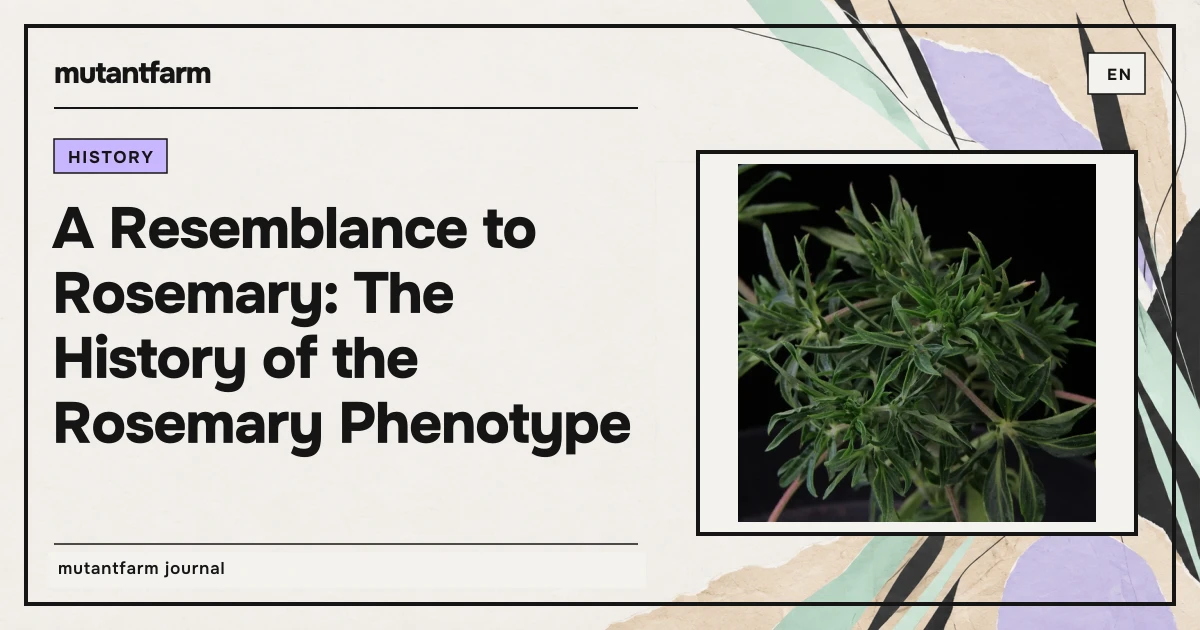
Hey, bro! One of Rosemary’s parents has small, unusual leaflets, with the history of Australian Bastard Cannabis behind them. The other’s leaf is so deeply divided that it looks like a fern. Their offspring produced a third variant: narrow, elongated segments that resemble rosemary.
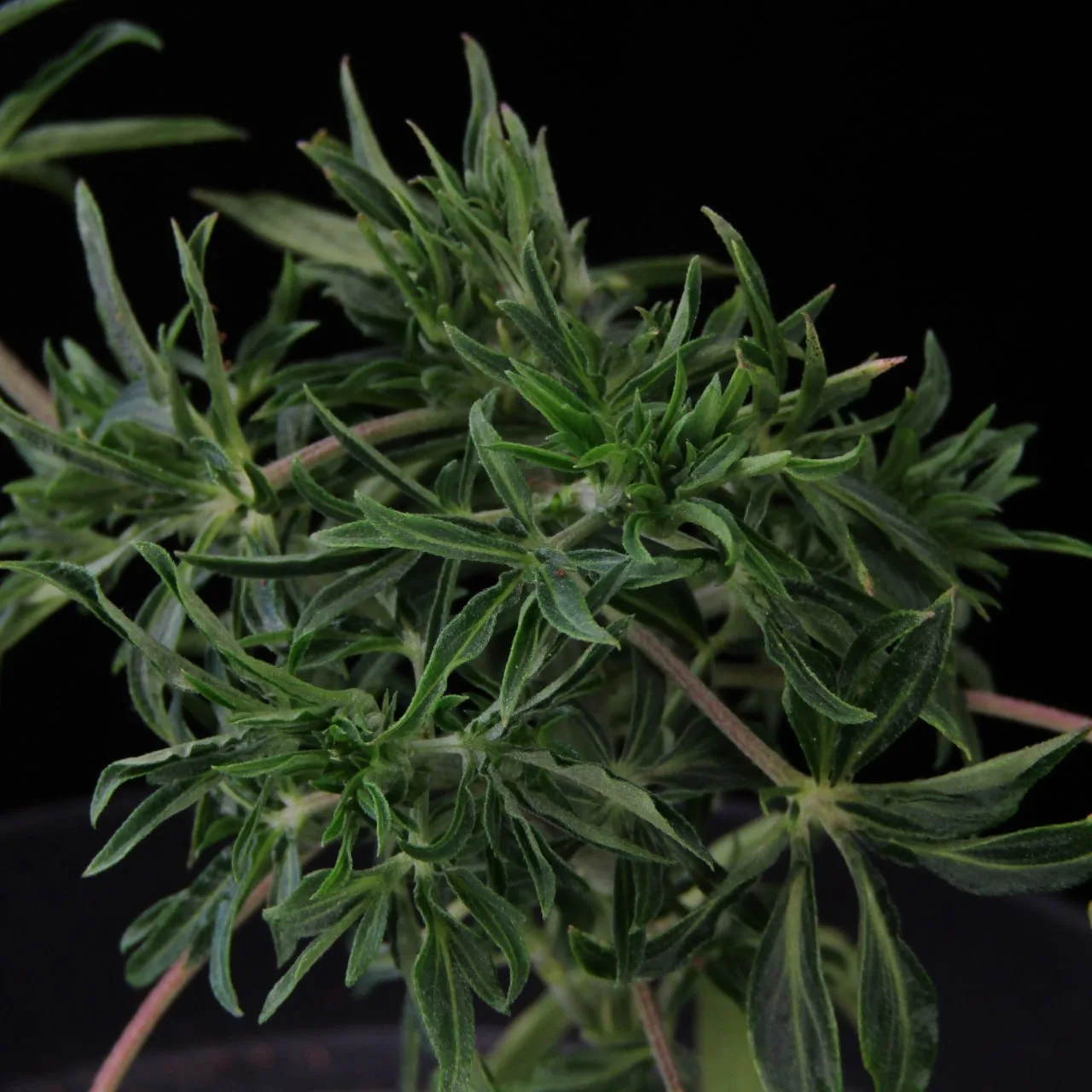
Its history is shorter than that of ABC or Ducksfoot: it has no decades of distribution under one name.
What the name means
Its main trait is narrow leaf segments.
Rosemary is the English name of the herb. True rosemary, Salvia rosmarinus, belongs to the mint family, Lamiaceae, and cannabis to Cannabaceae, so the name refers only to a visual resemblance. Rosemary in Kew’s reference database
Other mutants are named the same way: Freakshow has a “fern-like” leaf, and Ducksfoot is a “duck’s foot” with webbing between the lobes.
The Australian branch
One of Rosemary’s parents, Drunken Bastard, is a modern line from the ABC family. Australian ABC became known worldwide after the Cannabis Culture articles in 1999, and its early history involves Mr Ayers and Dana Larsen. Cannabis Culture readers’ first introduction to ABC
Next in this story comes hyb, the creator of Subterfuge No.1. 7East Genetics lists Subterfuge and Sangria in Drunken Bastard’s ancestry, so it is a distinct modern line within the ABC family.
My project began with an existing line that had its own creators and keepers.
ABC’s journey is covered in detail in the separate history of the Australian bastard. For Rosemary, the chain is ABC, then hyb’s Subterfuge line, then Drunken Bastard from 7East Genetics.
The Freakshow branch
The second branch leads to Shapeshifter, Jordan, the creator of Freakshow. Freakshow’s parents are given as Pineapple Express and Holy Chiquita, also known as Holy Banana. More on this in the history of Freakshow.
In Freakshow, deep incisions create many narrow sections of the leaf blade and a feather-like pattern. ABC lines have small leaflets with unfamiliar proportions and margins. Both parents are far from the classic leaf and also unlike each other.
An offspring of such parents receives many inherited variants from both, and a familiar trait can look different in a different genetic background.
How the two branches met
I described my work with Freakshow and Drunken Bastard in the report for the 2022 season. The English version appeared on ICMag on June 17, 2025: it is a transfer of older records and preserves the dates from spring 2022 and the names of the original plants. Freakshow and Drunken Bastard, the author’s report
The parents are Drunken Bastard #16 and Freakshow #4. Most plants looked far more familiar than their parents, but the November entries note extra leaflets overlapping one another and deeper indentations along the margin.
One plant had segments divided almost like Freakshow’s, with margins and outlines like the bastard’s. Another was closer to ABC. A third, with Freakshow morphology, was noted separately. Rosemary came from this family.
My archive has an entry dated November 4, 2023: “I’m going to call this phenotype ‘Rosemary.’” A photograph with the same date goes with it.
In March 2021, lilmanbigplan on Overgrow described his project with Freakshow, Subterfuge, and ABC Site 4, a different parental combination. lilmanbigplan’s project, 2021
The parental line names are the same, but the project and material are his own. The Freaky Bastard, January 2022
Rosemary comes from my line and is described in my reports.
What “mutation” means
In discussions of unusual cannabis, “mutation” can mean a change in DNA, an already known inherited trait, or simply an odd-looking specimen.
Rosemary is recorded as a phenotype, that is, by its appearance.
A “rosemary gene” and its mode of inheritance, dominant or recessive, cannot be determined from appearance.
So I record what can be seen: the leaf pattern, photographs of the plant, and its ancestry.
Leaves change with age
In cannabis, leaves change as the plant develops. A 2023 study followed the plant’s morphology throughout its life cycle: leaflet number, leaflet size, and total leaf area all changed. Different leaves on the same plant can differ noticeably. Morphological Characterization of Cannabis sativa, 2023
The 2024 work by Balant and colleagues also links differences in shape to the samples’ origins and development. Rosemary was not studied in these works. Balant and colleagues, 2024
The name Rosemary describes only the shape of the leaf.
Where things stand
The Australian branch runs through the ABC family and Subterfuge to Drunken Bastard, the other to Shapeshifter’s Freakshow.
I looked at the leaf, labeled the photograph, and recorded the parents.